Insights

Physical risks refer both to threats arising from acute and chronic climate events affecting company assets (under the CSRD), and to physical agents that threaten workers’ health in the workplace (under Legislative Decree 81/08).
For those managing electricity grids, motorways, railways and telecommunications nodes, the two meanings converge on the same asset. An extreme event affecting a substation or a section of a network puts the infrastructure, the service and the teams called upon to restore it at risk.
The CSRD requires physical risks to be reported alongside transition risks, which arise from the shift towards a low-emissions economy. For critical infrastructure operators, this reporting informs governance, maintenance and investment plans.
In this article, we will explore:
In business terminology, physical risks belong to two distinct regulatory frameworks: Legislative Decree 81/08 addresses workers’ health and safety, while the CSRD addresses the effects of climate change on company assets.
Title VIII of Legislative Decree 81/08 governs personnel exposure to agents such as noise, mechanical vibrations, electromagnetic fields, artificial optical radiation and microclimate conditions.
The Corporate Sustainability Reporting Directive (CSRD), Directive (EU) 2022/2464, instead addresses physical climate risks that can damage facilities and networks or disrupt their operation. It is one of the pillars of European ESG regulation, alongside the EU Taxonomy and the European Climate Law.
Microclimate is the most evident point of contact between the two areas. A heatwave that overloads an electrical substation forces maintenance teams to work outdoors in extreme thermal conditions, precisely when the facility requires urgent intervention.
Preventing climate risks affecting assets therefore also reduces emergencies in which personnel work under thermal stress.
Protecting infrastructure becomes a condition for ensuring the safety of those who manage it.
The distinction between physical and transition risks is the basis of ESRS E1, the CSRD standard dedicated to climate change. Companies must identify both categories, assess their materiality and describe their expected financial effects.
The classification of climate hazards comes from the European Taxonomy, Regulation (EU) 2020/852. Delegated Regulation (EU) 2021/2139, adopted under the Taxonomy, groups hazards into four families (temperature, wind, water and solid mass) and distinguishes acute from chronic phenomena within each family.
The two types of physical risk are:
Transition risks are linked to changes in rules, technologies and markets accompanying the shift towards a low-carbon economy. For an infrastructure operator, they translate into:
The CSRD applies the principle of double materiality to both categories. The company assesses the impact of its activities on the environment and people (impact materiality) and, in parallel, the effects of climate and the transition on its financial performance (financial materiality).
For governance, this means bringing climate risks into assessments by the board of directors and into industrial plans, with information subject to auditor assurance.
Under Directive (EU) 2026/470, in force since 18 March 2026, reporting obligations focus on companies with more than 1,000 employees and net turnover exceeding €450 million. For large infrastructure operators that exceed these thresholds, climate risk reporting remains mandatory.
When uncertainty is the rule, resilience must be a systemic choice: a forward-looking strategy grounded in scientific evidence.
Climate risk assessment for linear infrastructure must cover the entire network.
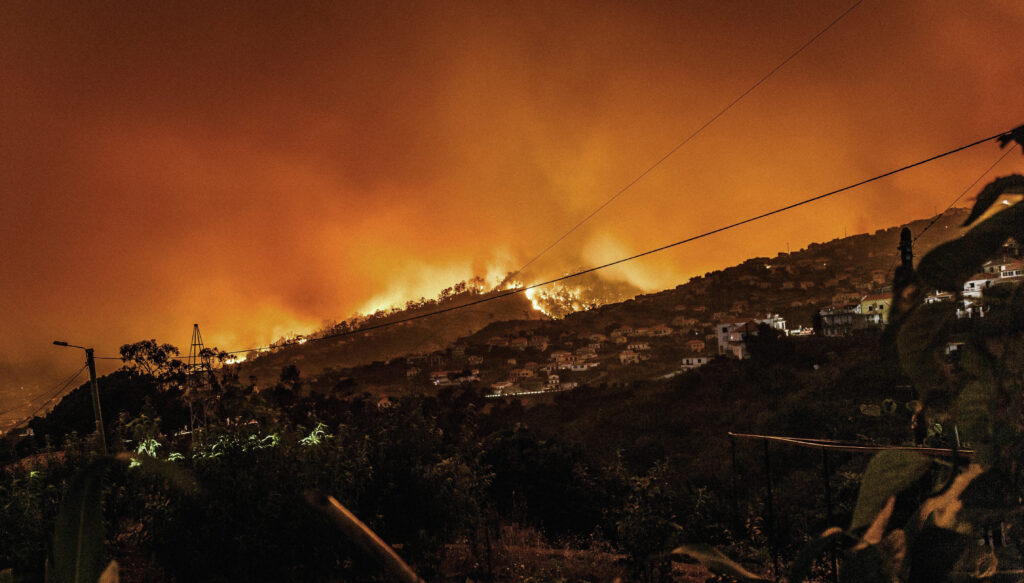
A power line, railway line or motorway can cross hundreds of kilometres of territory exposed to different hazards. Damage to a single segment can propagate along network connections. A damaged node can disrupt an entire area and generate cascading service interruptions across connected infrastructure.
Let’s look at two concrete examples:
To compare such different scenarios, the assessment must combine hazard, exposure and vulnerability for each network segment. This reveals the sections and critical assets where risk is concentrated, both today and under future climate scenarios.
Airis, Eoliann’s platform, performs this analysis on point assets and linear infrastructure. It combines satellite data, artificial intelligence and scientific models to estimate the probability, intensity and physical and economic impact of extreme wind, wildfires, floods and landslides, with projections up to 2050.
The same results support CSRD reporting and predictive maintenance.
Returning to the examples, a DSO can schedule vegetation clearance along feeders most exposed to wind, while a TSO can plan interventions on lines crossing areas at high risk of wildfire.
Climate resilience and operational continuity create value when they become part of investment planning.
An expected loss estimate, meaning the average expected economic loss for an asset or network section, makes it possible to compare the cost of a preventive intervention with the cost of the damage and service disruptions it avoids.
For CFOs and Risk Managers, predictive data become the basis for justifying budget decisions to the board of directors and institutional investors. The same analyses document how the company manages physical and transition risks.
Reporting based on scientific data limits exposure to administrative penalties for non-compliant disclosures, while preventive interventions reduce material damage.
The benefits for the company concern both investment and management:
Achieving these benefits requires risk estimates calculated for each individual asset and network section, expressed in economic values that can be compared with the cost of interventions.
Book a personalised Airis demo and discover how to turn climate risk into operational decisions.
Physical risks arise directly from the material impacts of climate change on company assets, such as floods or heatwaves. Transition risks, on the other hand, arise from the shift towards a low-carbon economy and include regulatory changes, technological developments, and reputational or market dynamics.
Although Legislative Decree 81/08 focuses on protecting workers (e.g. exposure to extreme temperatures or noise), the CSRD requires companies to assess the impact of climate change on their assets. If infrastructure is not resilient, restoration work under extreme weather conditions directly exposes personnel to higher occupational physical risks, bringing the two areas of protection together.
Through geospatial data platforms such as Eoliann’s Airis, mathematical and climate models can be combined to calculate the probability, intensity and potential economic impacts of extreme climate events on individual nodes within an infrastructure network, making it possible to plan preventive maintenance and strategically allocate CAPEX.
Floods, landslides, wildfires, extreme wind and heatwaves affect different sections of power lines, railways and roads in different ways. Risk assessment therefore analyses each section and strategic node, because a local interruption can halt service across the entire network.
Discover related content.
Want to go deeper?